NASA Article
Official briefing
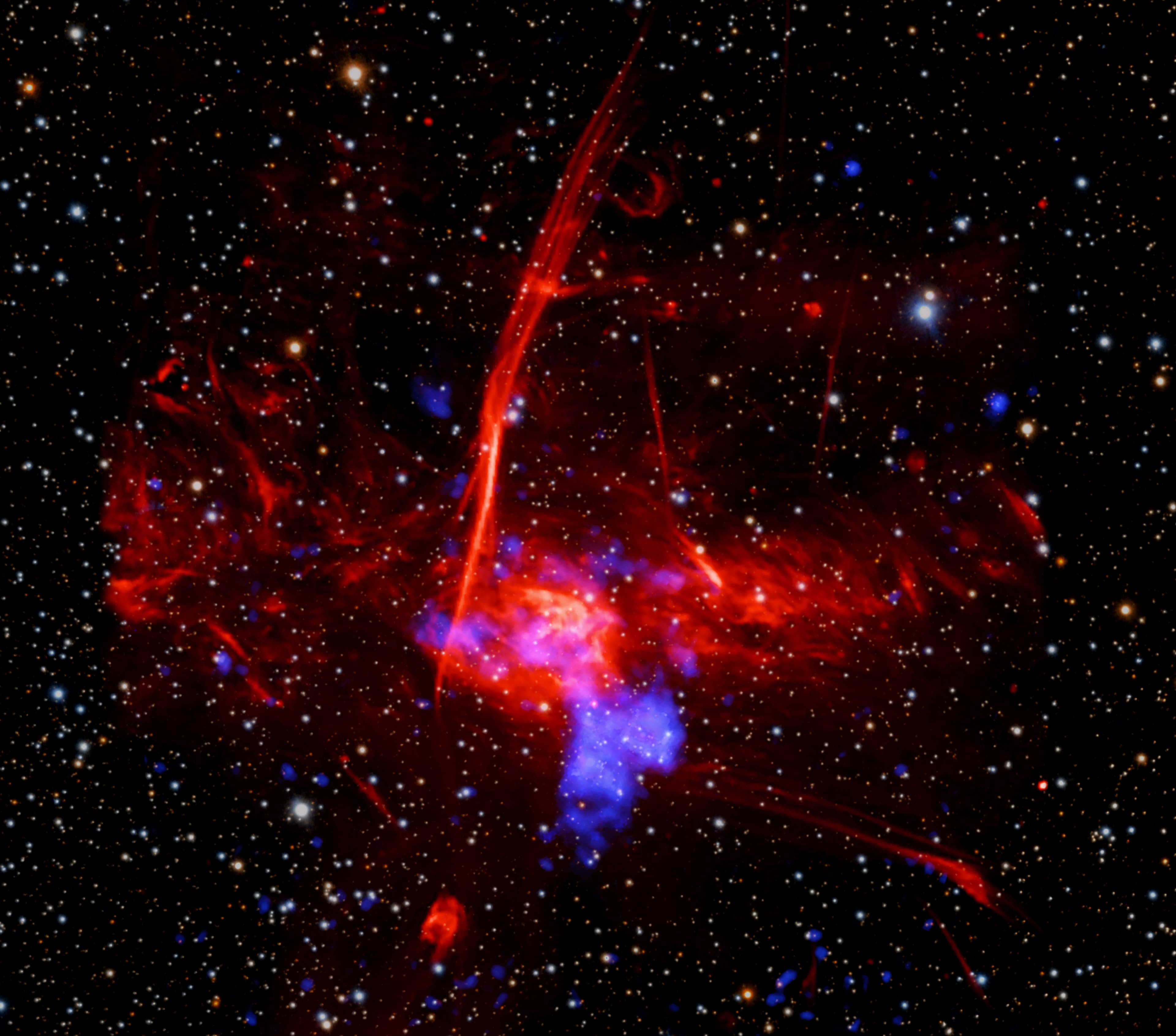
Do you see that blue blob to the lower right of the image center? Astronomers think that it shows where a massive star exploded as a supernova whose light reached Earth 1,700 years ago. The image combines optical data from the PanSTARRS telescopes in Hawaii (background stars in red, green, and blue), radio from the MeerKAT telescope in South Africa (large red cloud) and X-rays from NASA's Chandra X-ray Observatory and ESA’s XMM-Newton (shown in blue). The large cloud is a star forming region called Sagittarius C, which is approximately 50 light-years in extent and about 26,000 light-years from Earth. It is located only about 260 light-years from the supermassive black hole in the center of the Galaxy (off to the left of the image). If the blue blob is confirmed to be a supernova remnant, it would be one of the closest ever discovered to the Galactic Center. In this dense region, the deaths of massive stars are connected to the birth of new stars through gas and magnetic fields in a complex way.
Open NASA mediaCOSMOS Guide
AI mode will be activated soon
In one breath
Do you see that blue blob to the lower right of the image center? Astronomers think that it shows where a massive star exploded as a supernova whose light reached Earth 1,700 years ago. The image combines optical data from the PanSTARRS telescopes in Hawaii (background stars in red, green, and blue), radio from the M
What to look for
Look for shape, color, and brightness differences between galaxies; those clues often separate young star-forming regions from older stellar populations.
Source note
This explanation is a static educational guide derived from NASA's APOD title, description, and media context. AI mode will be activated soon.
Why This Matters
A larger human story
Galaxies preserve evidence of gravity, star formation, and cosmic time, so a single image can become a map of how structure grows across the universe.